
The Rug Cleaning Case Study You'll Never Forget
How and Why How To Clean Persian Rugs Will Change Forever
Table of ContentsHow Persian Rug Manufacturing are Changing the WorldThe top info about Persian RugsWhy How To Clean Persian Rugs are so Popular
For this reason, it's difficult to imagine that the Mongols or the Seljuks or any conquerors had the ability to ever completely stamp out the ever-evolving art kind. Ardabil Carpet. Image via the Victoria and Albert Museum. The dramatic florescence of the Persian Carpet in the Safavid duration has actually been labeled by historians as the "Carpet Design Revolution." The increased existence of curvilinear designs would have required a considerably more complicated weaving system than heretofore seen - handmade.
The brand-new style of carpet was so complicated that artists needed to be commissioned to paint the style, which would then be passed over to weavers, although it's rather uncertain how the weavers had the ability to exactly match these images to the end product. Shah Abbas in Venice. Image by means of Wikipedia. large.
https://www.youtube.com/embed/vzxXVzMFAQQ
The records from this duration are also even more complete so weblink Oriental rug cleaning service we can get a much better grasp of where and for whom these carpets were made. Shah Abbas, the globally-minded ruler of the Dynasty, sent some of his finest carpets to Europe, where they immediately ended up being fashionable. modern. This trade with Europe, specifically with Venice, increased the presence of the kind.
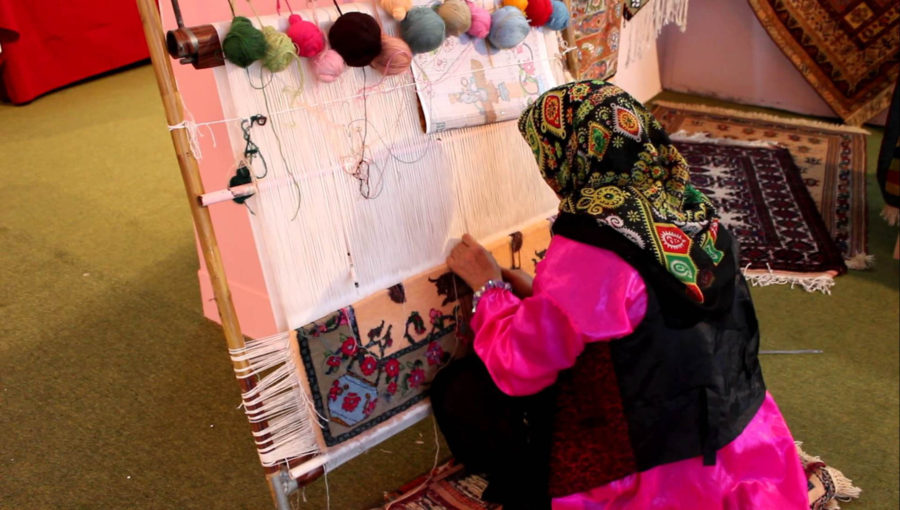
Though carpets affected by the Safavid duration continued to be made, nothing would match these masterworks, nor would the area experience rather the very same degree of patronage from any subsequent ruler. Image via Pinterest. large. Weaving one of these detailed stack carpets can take anywhere between months and years - traditional. Warps and wefts must first be combined to form the basis of the of the rug.
Wefts are passed through these rows of knots to secure the stack, then beaten down with a comb to compact the finished row to the remainder of the carpet. And if this is tough to comprehend, you and I are absolutely in the same boat, but take a look at the video below and it ought to clear a couple of things up: The style of knot is critical in identifying the design and origin of the rug.
The top 7 things Persian Rug Collectors can help with
 Why The History Of Persian Rugs is So Popular
A Persian knot does not necessarily make the rug a Persian rug, nor does a Turkish knot make the entire piece Turkish in style. These specialized knots are used in numerous parts of the world and Turkish knots are also used in Persian rugs. The Safavid Empire. Though the contemporary definition of a Persian carpet merely implies anything woven in modern-day Iran, the initial reach of the Persian Empire would have affected ethnic groups beyond the reach of contemporary Iran.
These variations are less and less obvious, since the majority of nomadic weaving has actually totally ceased. Each subregion had varying access to the requisite materials. Goat hair, cottons, dyes, colors of wool; all these factors could differ region to region. There is even variance within particular ethnic groups - cream. For example, Kurdish rugs are so different in terms of quality and style, it's difficult to make generalizations about any overarching concepts or construction approaches.
Image by means of Tripadvisor. blue. Persian carpets continue to be made in modern-day Iran, however the trade is continuously under fire. Modern, machine-made carpets are far less costly and sanctions on Iran have hindered the export of these well-known pieces. As in lots of other places worldwide, standard handicrafts are on the decrease.
In 2017, Iran exported around $24 million in carpets once the sanctions were raised, but other countries, like Turkey, control the trade. round. If you're starting to consider getting your own Persian rug, you'll desire to proceed thoroughly. There are lots of websites providing these charms for numerous grand, however you'll likely want to check the pieces yourself face to face.
Antique dealerships may be the best bet, due to the fact that those regional rug shops that constantly seem to be closing aren't super trustworthy. Folks hypothesize that these stores' blowout closing sales are really a scam to move item that is far less valuable than the pricepoint would suggest, much in the same way that outlet store compute for substantial markups and markdowns - red.
The only Persian Rug Fabrics Guide You'll Ever Need
Image through Iran Chamber. Unlike Navajo Rugs, the history of the Persian Rug is even more diffused throughout time and distance. Arabesques, medallions, and subtleties in wool color can speak volumes to professionals, but might stump the layman (floral). Like much of our preferred things, the learning curve is steep, however the benefits are valuable.
 Some Facts about Persian Rugs That People Overlook
Presenting, a series that carefully analyzes the history, significance, and creation processes behind the most interesting types of collectible art and antiques. round. What makes a Persian carpet so extremely desirable today? Much of a carpet's rarity and worth has to do with how it was made both the procedure and materials used.
Later, throughout the 16th-century Safavid period when Shah Tahmasp introduced carpet production factories at court, carpet making developed into a more established craft and owning carpets developed into a status symbol. Weavers began to integrate more complex, formal designs into their masterpieces that became connected with Persian carpets.
 12 wacky things About Persian Rug Collectors That Will Change the Way You feel
The thin borders rich crimson background establishes stylish contrast against the floral themes present throughout. These exact same styles are at their most specified at the core of the antique carpet, where they are magnified in regards to size and color. The floral aspects overlap and draw attention to their individual form, all while sticking out on their own through the experienced usage of dynamic highlighting.
He signed treaties with European nations like Spain and England and brought silk merchants to the then capital city, Isfahan. Later, when the Afghans got into Iran in 1722, Persian carpet making decreased up until European need became strong in the late 19th century (white). Traditionally, proficient carpet weavers used top quality silk and dyes to hand make what were considered the most important of Persian carpets.
